Pull up the org chart of any company you admire. Hundreds of names, stacked in boxes, stacked in layers. Now play a game with it. Delete every box whose work an AI agent could do today — not perfectly, just credibly. Cross out the box, keep the judgment.
When I run this game, the chart collapses to about seven boxes. And the seven that survive are not the ones doing the most work. They're the ones holding the judgment no agent can hold yet.
That collapse is the whole idea, so it's worth sitting with why it happens.
For most of history we sized teams by work. Work was the scarce, expensive thing — someone had to write the code, draw the screens, answer the tickets, run the numbers — so headcount was a fair proxy for capacity. More people, more output. The org chart was really a map of who does what.
Work is no longer scarce. An agent will write the boilerplate, draft the doc, run the test suite, summarize the market, generate the first three design directions, and do it again at 3am without complaint. The amount of executable work a team can absorb is now elastic, close to free. What stayed scarce is the thing agents are still bad at: knowing which work is worth doing, and whether the result is any good.
So the unit of a team changes. You stop sizing by how much work there is and start sizing by how many distinct kinds of judgment the product needs. The org chart stops being a map of who does what. It becomes a map of where human judgment is irreducible.
"Then why have a team at all," someone will say. "Why not one genius and infinite agents?" Because judgment doesn't generalize. The person with an Apple-level feel for the exact weight of a swipe is almost never the same person with a gut for how a distributed system fails under load, who is almost never the one who can smell whether a market narrative will land. Taste is domain-shaped. It doesn't transfer. So you need exactly as many humans as there are irreducible domains of judgment — and for a real product, that number lands around seven.
Here's the shape I keep coming back to. Old organizations scaled the way you scale a chip by adding cores: bolt on another person, get a little more throughput. But each new core helps less than the last, because every core has to talk to every other core. Meetings, alignment, handoffs, the slow tax of coordination. Past a point you're paying mostly to keep the cores in sync.
An AI-first team doesn't add cores. It widens them. One human control unit driving a fan of execution lanes — agents — each lane running real work in parallel. You don't go faster by hiring more people. You go faster by giving each person more agents. One employee stops being one employee and becomes a small command center.
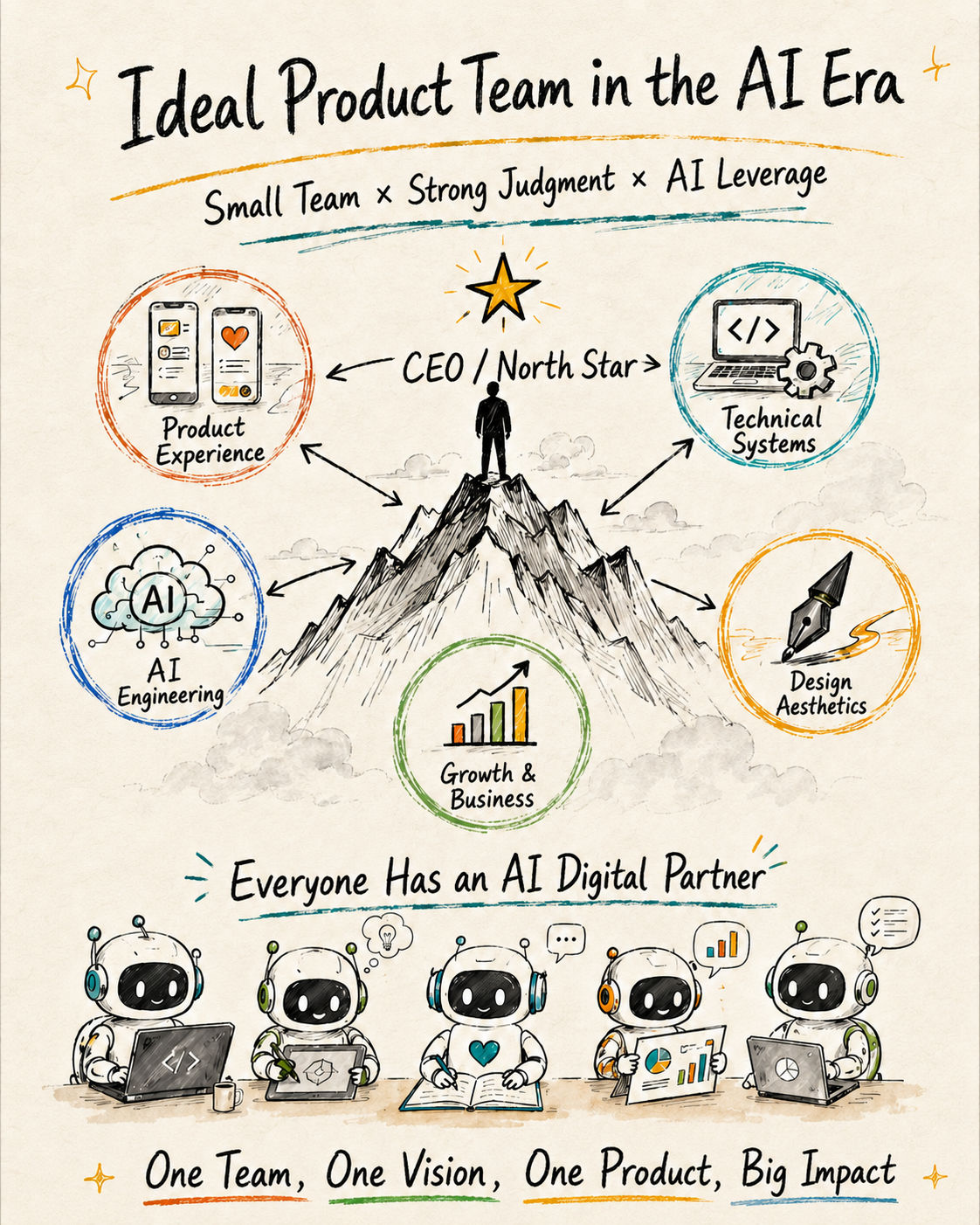
The seven control units are these:
- The Polar Star. A CEO-like leader who owns what to build and why. The pentagon-warrior across product, tech, business, design, and story. Everything else in the team serves this seat's conviction. The scarce thing here isn't breadth — it's the courage to see the future before it's obvious.
- Client experience. Owns how it should feel. Interaction, motion, speed, the texture of the first touch and the thousandth. Not "the frontend" — the bridge between human intention and machine capability. The bar is Apple.
- Backend and systems. Owns what must not break. Data, reliability, the parts that stay invisible so the visible product can shine.
- AI and agentic engineering. Owns how the team itself runs. Turns human tasks into agent sessions, redesigns the work into processes that humans and agents share. This seat builds the execution lanes the other six ride on.
- Design and taste. Owns who the product is. Not decoration — personality. In a few years most products will be technically strong; only a few will be emotionally remembered. This is where that gets decided.
- Growth and business. Owns whether the world adopts and pays. A product isn't successful because it's well built. It's successful when it's understood, trusted, and paid for.
- Legal, finance, operations. Owns whether the company survives its own success. Maybe not full-time on day one, but never absent.
Seven seats. Each one a human plus a swarm of digital mates — coding agents, research agents, design and review and ops agents — woven into how the person works, not bolted on beside it. AI isn't a tool the team reaches for. It's the operating system the team runs on.
And here the chip metaphor breaks. It's worth saying where, because the break is the most important part.
A control unit has no taste. It issues instructions and feels nothing about the result. If that were all a human added — scheduling work, dispatching it to lanes — then you really could replace the seven with a better scheduler, and you should. But that's not why these seven survived the delete game. They survived because each one cares about something the agent is indifferent to: the exact curve of an animation, the dignity of an error message, whether the whole thing has a soul. The metaphor fails precisely at the word soul, and that failure is the answer. You keep humans not because they compute, but because they have a stake and a taste an agent can't fake.
So the question for an AI-era team stops being how many people do we need. It becomes how many kinds of judgment does this product deserve — and then: hire for exactly those, amplify each one tenfold, and let agents carry the rest.
There's a second way to read the seven seats. They aren't only a map of a team — they're a sequence. One founder, alone at the start, takes them on one at a time as the company moves from idea to scale. The Polar Star first, because nothing matters until you know what's worth building. Then the engineering and experience seats, as you build the smallest thing that proves it. Then growth and systems, as you try to make it repeatable. Then taste, finance, and law, as you turn a bet into a business. The org chart and the startup lifecycle are the same picture seen from two angles.
And the same logic shows where this thesis is weakest. When building gets this cheap, the temptation is to mistake the prototype for proof — to scale execution far ahead of evidence. The discipline that survives is restraint: keep your sense-making ahead of your building. The seat that holds that restraint, and the one no agent will ever hold for you, is growth and business — whether the world actually adopts and pays. Building was never the wall. Distribution is.
This is the team I want to build. Seven people who each give a damn, each made ten times stronger. Small enough to keep a soul. Strong enough to move like a hundred.